
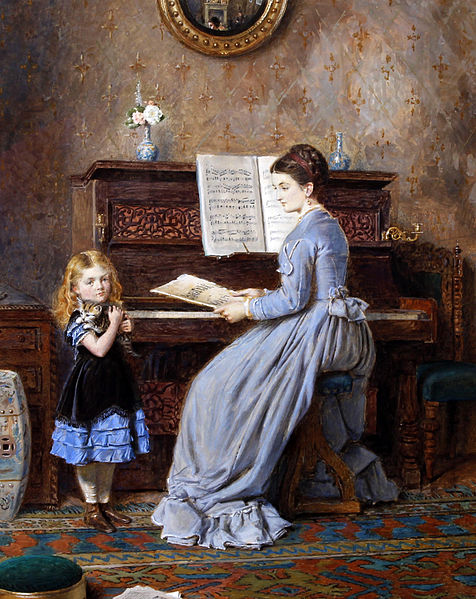
 Kilburne, The Piano Lesson (1871)
We all can imagine the situation: Jordon or Kayla resists practicing, will not prepare for lessons, and certainly does not appreciate the time, money, and effort expended to make lessons possible. So, is it worth it to continue?
First, a disclaimer. I had to be vigorously pushed by my mother to stay with the piano, despite being a good pianist. Pushed, forced, you name it: she did it. And, yes, I resented it, plus I broadcast that fact to anyone who would listen. I can remember random adults saying to her, “Well Minna, Carol says she doesn’t want to practice, so maybe you should just let her quit.”
Not my mom!
Remember, too, that children rarely appreciate what is being provided them along the way. My mother’s pushing, whether I liked it or not, kept me going. Piano became the key to my life, leading to graduate studies in music. These opened a path, via musicology, that fulfilled my dream (vaguely conceived as a seventh grader) to find a way to study in Russia. I also made considerable money during my teens as a pianist and organist. So there were practical applications for playing the piano too.
But my particular experience does not necessarily apply to a mother today, tearing her hair out and wondering whether to continue lessons for a recalcitrant child. So l will offer these thoughts, several especially applicable to students in their first years of study.
Let me start with this assertion: studying the piano works best when it becomes part of a bigger whole. What do I mean by this?
Music is not meant to occur in isolation. Children who begin with band or orchestral instruments, or in choir, immediately find themselves part of something bigger. They belong to an ensemble where they make music with others. Their individual practice, to whatever degree they do it, serves not just to make their own musicianship better, but to improve the whole.
Kids in band and orchestra, once they reach a basic level of proficiency, play chamber music (duos, trios, quartets, quintets) and get to go to summer clinics or festivals where they interact with children from across the city or across the world. The same is true of choral students who rehearse and sing together in choir concerts. If they have a modicum of talent, they may find themselves singing in other settings like festivals, theatrical productions, church services, or ensembles that bring music to hospitals and nursing homes. These experiences seem far more glamorous than practicing for a weekly piano lesson.
So, what are some solutions?
First, acknowledge the problem. Practicing the piano can be lonely for children. There go the other kids: playing on sports teams, riding bikes, chattering away down in the basement while folding clothes with a sibling, or engaged with a cast of characters in their imagination while reading books. Meanwhile, there sits the “piano kid,” alone in the living room, struggling to practice.
One solution may be asking you, or someone else, to sit nearby during practice. Organize plans, mend clothes, answer emails, or simply close your eyes and get a few precious moments of rest, but be nearby. Practice the discipline of saying nothing unless the child asks. Just be the presence that makes practicing less lonely.
Second, do what you can to help the pieces your child plays sound more dynamic. Create an accompaniment to the child’s “beginner’s song.” One and two-line songs in method books, stumbled through dispassionately by a child, can come alive if a second person plays an umm-pah-pah, adds a drone of harmony down in the bass, or taps out a rhythm with a tambourine.
Third, ask the teacher to assign and play as many duets with the child as possible. Obtain a book of simple duets for the home. Learn to play well enough yourself, if possible, to manage the second part, or ask someone else to play or record a version of it. When possible, have someone play guitar, mandolin, ukulele, recorder, autoharp, or whatever else is available.
Fourth, if your child isn’t singing along with at least some of the melodies of the pieces, then do what you can to help that happen. We grasp melodies instantly when we sing them. We cannot sing without being fully engaged. The singing voice, via the musical ear, can teach little fingers as much, if not more, than any other aspect of music. Even your singing voice, applied to the simplest beginner’s tune, will turn that piece into something dynamic. If singing seems too hard, try vigorous humming!
Fifth, look for another person (sibling, neighbor, colleague at school or church) who is studying an orchestral instrument. See if you can get both persons together to make music. You’d be surprised what even the youngest kids can come up with as they create their own chamber music.
Sixth, do not discourage creative messing-around with the pieces that the child is learning (as long as sufficient “practicing” is getting done). Children can chafe under the boring strictures of beginner’s repertoire. They want it to be more colorful, more rhythmic, more dynamic. Yes, they need assiduously to gain skills to move up to more stimulating music, but also let them experiment, decorate, and innovate within their “boring” piece, as long as they get their basic assignments completed.
Seventh, try to find ways for the child to use whatever skills he or she has with piano in a public forum. This may mean accompanying a friend who sings or playing for a peer in a school recital. Find chances for the child to bring the uplifting joy of music to those who are shut in. Watch eyes light up as your child stumbles through even the simplest pieces in a facility where people are isolated.
Eighth (and this is the hard one), consider changing teachers. Even with the most-recommended teacher in town, your child may not be inspired. The beauty and excitement of learning music is not always enough if the child is not feeling those energies. There needs to be some kind of awe for the teacher and a sense of expectation about each lesson. Highly experienced and roundly recommended teachers may be marvelous, or they may have once been marvelous. Teachers can lose steam over time. Or, understandably, a teacher may not be motivated struggling with a student who isn’t bringing his or her “A” game to the lesson. That important fact of life might as well be explained to the child now!
If you do make a change, consider looking for a young (but skilled) pianist. By this, I mean a college music major or possibly even an advanced high-school student. This relationship may not be a long term one, but children who are “stuck” in their music study can be jolted by the combination of dynamic energies coming from a younger teacher and a desire to emulate and gain the praise of that new teacher.
Finally, consider changing to a different instrument. I would have loved to have played in band or orchestra. My piano playing and general musicianship would have benefited from the stimulation of playing a vastly different instrument in an ensemble.
Let me know your thoughts. And remember, it may be right for a child to quit music lessons for many reasons! And sometimes a year off, or two, is also a good thing, again for all kinds of reasons. But it’s best to examine the obstacles before throwing in the towel.
I was the opposite – I was a gifted pianist and cellist and was even invited to play with the local philharmonic orchestra in 5th grade! We lived in a major city which offered music lessons to all students beginning in early elementary school. Instruments were rented at a low price and the piano was furnished for free. However, a move to a small town meant I had to give up orchestra altogether. Students at the new school could not begin learning instruments until 7th grade and then they played with the hopes of joining the high school marching band starting in 9th grade. In the spring of my 6th grade year, the band director visited our class and told us all about the music program. We were instructed to write down our two top choices of instrument we hoped to play the next year. I will never forget him calling me up in front of the entire class and mocking me for writing down “piano” and “cello” as my two choices. “You can’t march with either of those!”, he cried to an audience of cackling 12- and 13-year olds.
I chose to play nothing. My skills languished, as I no longer had access to either a cello or piano.
Fast-forward to adulthood. After having children, our first major purchase was a baby grand piano (at a consignment sale – $900!!). I now have a 15-year-old who plays classical piano beautifully it brings tears to my eyes. My 9-year-old is quickly following in her sister’s footsteps. Our middle child is our master chess player – piano was not for him (but it’s okay – he found his niche).
Even though I did not always enjoy my lessons (I, too, complained!), I can see now how important they were. My parents did not know enough to try to keep them up outside of the school when we moved. They did not realize how helpful music was or all of the ways it could have continued to enrich my life. If you are at all able to do this, encourage your children to take up an instrument (or encourage any similar skill – in my son’s case, chess) and help them to stick with it. Unlike most sports or other organized pastimes, music is something that a child can continue as a pleasurable pursuit for a lifetime.
As Carol states, changing piano teachers can be a key to bringing joy into playing the piano. I had my oldest son (a good pianist and age 17) teach my youngest son (age 8) for his first year of piano. My oldest son had already taught his younger sister for her first year of piano and all went well. But my youngest son did not like piano and did not like to practice. He said he could not wait to be done with piano and begged me to let him quit or switch to violin. We have required all our kids to have two years of piano lessons, so that was non-negotiable.
But then for his second year of piano, I switched my youngest son to the experienced teacher (in her 60’s) who taught my older son, who liked her very much (though I have heard of other students who did not like her at all). Honestly, I didn’t have much hope for my youngest son and piano, but I wanted to give a different teacher a try. To my delight, after one lesson, my youngest son told me that “it was awesome!” He immediately started practicing the piano more and experimenting on his own. He kept up the enthusiasm all that year and is now in his second year with this teacher. He is doing very well and wants to keep playing the piano all through school. He likes the piano so much that he doesn’t want to try any other instrument.
What creative suggestions, Carol! Hope many a frustrated mom will take heed!
– Mom of Bethanie, one of your former students
Thanks for the encouragement and suggestions. I am Grandma and piano teacher to my young grandsons. I need to remember to keep it fun and I like your suggestions.
I grew up in a musical family. Both of my parents were music majors. My mother was the local orchestra director in the public school and always taught private lessons at home. My father was a band director until he opened his own Music Store. Both are adjunct professors for music at the local college and also participate in numerous musical assemblies in the community.
Needless to say there was always classical music playing in our home.
I also had the opportunity to play numerous instruments, non of which I ever felt very good at. Probably because I was a beginner surrounded by professional musicians.
In retrospect, I am so thankful for being exposed to all of this music- including lessons that I to struggled through!
Listening to my parents practice and the many students that came to the house for lessons taught me how to practice. Not only a musical instrument, but to practice anything in life. Hours and hours of playing the same (boring) measures of a piece of music to perfect it taught me discipline and patience. Recognizing those same perfected measures played by an orchestra weeks later brought me great joy and understanding of why the hard work of practicing must be done.
Later in my life I moved to Germany, where I swore I would never learn the language. I had failed at trying to learn Spanish from a textbook in college. I was told that I would never learn a second language and I believed it for years!
When I was immersed in what I call the melody and rhythm of the German language, the part of my brain that had been trained by listening to hours and hours of classical music (as background music in my home growing up) kicked in. I was fluent in German within a year! I couldn’t believe it myself. Listening and learning the language came naturally to me because my mind had been trained to do so through music.
I didn’t learn any of these skills in school, rather I picked them up only through the environment I was exposed to.
Now we try to expose Our own children to as many musical experiences as possible. We have a rule that our children must learn to play a musical instrument. They can choose what they would like to play and must stick with it for a year. After that they can choose to continue that instrument or switch to another instrument of their choice.
The joy and worth that music brings to our lives is worth the tears, frustrations, muddling through the challenges of practicing and the extra time we parents put in to make it happen. I am so thankful to have the opportunity to give my children the gift of music. Sometimes, if I am sneaky, I can even catch a glimpse of my children smiling while they practice.
Thanks Carol. Wish I had had these possibilities growing up. I’m sure I would have practiced more. It was lonely practicing especially when the old piano was in the dark dank basement!!! Haha!!
Miss you❤️ Stay safe!!!
Thank you for this encouragement! My daughter is 6. I started her on the piano and violin last year, but our lessons fizzled after Christmas break. Having her practice was sometimes a chore and she was bored with the beginners work, like you said. I plan to continue with lessons this year, and this blog post solidified that for me, but I can’t quite figure out what is right for her: to learn just one instrument right now or both. She prefers the violin but I also feel the piano is so important! I know this also might depend on the child, but if you have any thoughts on this I would appreciate hearing your opinion! It has been a bit of a road block for me to move is forward.
When my son was 13, he was a very gifted pianist. But he was 13 and to be honest, we were having a lot of battles over piano practice, over long hair, over bad manners, over school work, so many battles. I just wanted to let the battle over piano go away. So I let him quit his lessons. “he’ll come back”, I said. The boy is now 26 and he has never touched a piano key since he was 13 as far as I know. I still regret this. Wish I had better advice at the time, such as you have just provided. To end on a happy note, his manners are much better, he became a star student, his hair is very nicely groomed and the boy now makes more money than he knows what to do with. So there is that!
My 10 siblings and I were homeschooled and music was an important part of the curriculum. We all knew that quitting piano or our stringed instrument of choice (we all played piano and a string) was not an option. Music practice was as important as math practice in our house. At the time, we didn’t always appreciate it, but today we are all thankful that we were forced to practice and perform. Our parents investment of money and motivation is paying dividends today as most of us are involved in our church music ministries. We enjoy playing in ensemble when we gather at family reunions. Finally, we all also acknowledge that learning the diligence and persistence required in music practice prepared us with the character and strategies for tackling life’s challenges. So, I’ll say to my parents here what I would never have said at age 12, “Thank you for making me practice!”
Agreed! My grandmother let my mother quit, and she regretted it so much that she never wavered through all our drama as my siblings and I had to play piano and a brass instrument and perform in an a capella family band. I am so, so thankful for her guts, because I certainly pushed back for years and through many, many trombone teachers. I use both now and teach my own kids and never doubt pushing. I do allow flexibility in details of how it gets done, what constitutes practice during rough spells. But it’s non-negotiable and I am confident it shapes us in many ways.
I am in the throws of this right now. All of our kids are required to take piano through high school as a part of our decision to make that a part of our school curriculum. My 16 year old hates piano and all things related to it. I sit with her as she practices, I encourage, bribe, direct, and weep with her until we are both dehydrated. However, we continue because in her case it’s not about the piano.
Every new skill is fun at first. Later, the complexity of the more advanced skill makes it more work than fun. This is exacerbated in pleasure seeking persons and ameliorated in those who have a natural inclination for the skill. Once the skill is mastered, the fun and work together take on a new face, where the old fun is less pleasurable and the work less onerous.
For this child our goal is for her to learn that if she perseveres through the less pleasurable stage, she will learn something about her own strength and abilities. Instead of defining herself as a quitter, she will see herself as a “perseverer”. I won’t be sad if she never touches the piano again if she does learn that lesson. Thank you for the thoughtful article.