
Today, Dec. 5, on the fifth day of Advent, let’s consider a tradition that occurs tomorrow (Dec. 6th)—the commemoration of an historical figure who is actually an old friend to most of us.
Shoes and socks are important items. In Jesus’s world, the sandal reigned supreme. But for most of us, solid shoes and warm socks serve their greatest function in winter when they help us survive the icy elements.
But the emotional appeal of socks and stockings is strong. What is cozier than a favorite pair of socks? Looking backwards, think how many hours grandmas and moms had to spend knitting stockings for the family. Good socks and stockings still are a luxury in some parts of the world. And they can be expensive! Certainly in my youth, getting a run in our stockings was disaster and brought our mothers’ ire (in part, a hold-over from the days these mothers spent under rationing during World War II).
Shoes and socks function as symbols, too. Baby’s baptismal socks sometimes get tucked into a keepsake box. First booties may undergo a grand preservation by bronzing and engraving them with the child’s name and birth date. Little can we imagine how we’ll battle to keep shoes and socks on this child’s feet as he grows!
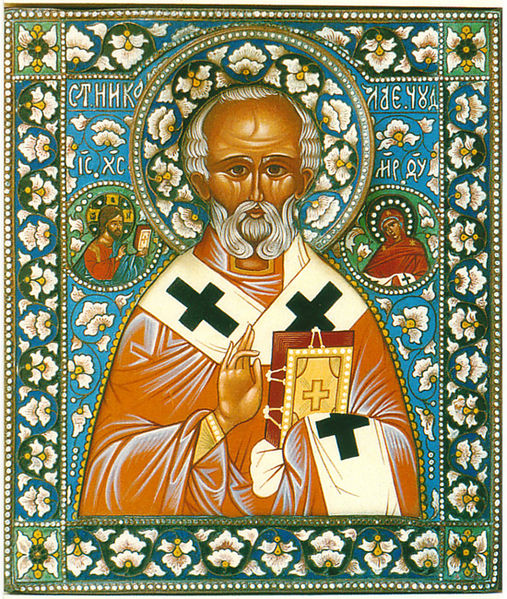
But maybe the jolliest use of shoes and stockings occurs tonight on the evening of December 5th. Tomorrow, Dec. 6, St. Nicholas will be celebrated across Christendom. That makes tonight St. Nicholas Eve, the time for the shoes and stockings to be set out in anticipation of the saint’s visit!
Yes, this European tradition is the source of our modern “Christmas stockings.” Worldwide, children will be placing shoes, socks, and stocking at the foot of their beds, in a hallway, or on the fireplace hearth. These children will fall asleep with the hopes of finding them filled with treats when the sun rises.
In recent years, our family has begun to practice this tradition. The “gifts” don’t have to be large, or even physical items. Family members can gather poems, jokes, or favorite quotes to fill the shoes. An older sibling might make homemade coupons, offering a service to delight the recipient: perhaps a promise to walk the dog for a month, do the dinner dishes, or spend more time playing “Play Dough” with the little ones. The goal is to enjoy the loveliness of the tradition (as opposed to racking up gifts).
But treats are nice, especially candy, right? And, indeed, that’s what will happen tonight on the ship where I presently am working as a Smithsonian Expert on a Rhine-River Christmas Market tour from Basel to Düsseldorf. The fun began in the early evening with the explanation given by our charming Polish travel director. She coyly invited us to open up our hearts and put our shoes out in the corridor before we went to sleep. Some travelers knew of this tradition and smiled, clearly delighted; but other travelers did not. Predictably, a bit of tittering could be heard: “Whatever could this woman mean? Putting out our shoes?” Let’s just say, it was clear, from some faces, that not everyone would comply.

Yet these people will be visibly dismayed in the morning when those who embrace the tradition will be rewarded with a shoe full of candy, fruit, and holiday trinkets. Year after year, I’ve seen this happen when I work the Christmas Market tours. In fact, the photo here is one I made six years ago when, around midnight on St. Nicholas Eve, I poked my head out in curiosity to see how many of our grown-up guests had complied. That year, most did, as you see.
Tonight, though, I’m not sure what St. Nicholas will find. And even once a person decides to put out shoes, the question becomes, “Which Shoes?” I debated between my clogs, my navy heels, or an ankle boot. The heels won, so we’ll see how they look in the morning, stuffed with colorful goodies.
As with so many things in the human experience, the value of this kind of symbol far exceeds its material content. Celebrating St. Nicholas is serious business in this part of the world. A number of years ago, on a particularly cold Christmas Market Tour, we were docked next to a small village along the Mosel River on St. Nicholas Eve Glancing out of the picture windows during dinner, we were astonished to see lights moving along the shore of the river! Upon closer look, we realized that the lights were lanterns held aloft by men who were swimming in the icy waters close to the riverbank, some wearing wet suits, and some not! These swimmers were leading a water-parade and illuminating a gorgeously dressed St. Nicholas, enthroned on a decorated wooden raft. The scene was magical: the lanterns illuminated the faces of the swimmers, the raft sparkled with candles, and St. Nicholas’s heavy velvety garments glittered, all against the dark, cold waters of the Mosel.
Of course, the history behind all these traditions is a serious one. It traces back to the 4th-century bishop known today as St. Nicholas of Myra. In his most famous act of beneficence, he afforded three impoverished sisters each a bag of gold coins (or golden balls), which provided them with the dowry necessary for them to be properly married, rather than be indentured into a life of slavery. From this particular event stems the concept of our St. Nick as a bringer of gifts. (On a different note, three golden balls became a medieval symbol for a pawnbroker’s shop!)
But the path to beatification and canonization for Bishop Nicholas was due not to this one deed, but to a multifaceted and complex life, including his role in preventing famine, saving citizens from punitive taxation, intervening in unjust executions, and his controversial actions at the famous Council of Nicaea in 325.
His icon (wearing a white stole with black crosses) is among those most frequently found in both Orthodox (Eastern) and Catholic (Western) Christian churches. For that matter, take any sizable city across Europe, Britain, Russia, Turkey, and even the United States. Count the number of churches named after Nikolaos, Nicholas, Nikolai, or Nikolsky. Think, too, of how many baby boys have been named after St. Nicholas, from farmers and cobblers to archbishops and tsars.
All of this history, art, and spiritual meaning really does stand behind each shoe placed out on the eve of Dec. 5. It matters not whether the shoe belongs to an excited child or a dubious adult tourist.
So tonight, perhaps you and your family might consider sharing in this old tradition. Or tomorrow, look more closely at the role the Bishop Nicholas of Myra played during the early period of Christianity. You may wish to read accounts of his life, or enjoy looking at the astonishingly beautiful icons of St. Nicholas created across the centuries. Every one of these activities allows us another glimpse into the richness of the Advent season.
Carol,
Thanks for the retelling of the St. Nicholas story! It is something all Christians should know–as well as they know the legend of Santa Claus.
This summer, my family decided we were going to join you at the cruise you are currently on. However, several things happened, including two stays for me in the hospital! I am still not able to travel, but my wife and I will be cruising again next spring. Hopefully, we can all catch you next year at this time. It is definitely a “bucket list” item.
If I don’t get back to you before December 25, a Merry Christmas to you and your family!
Bob LeFevre
Morgan Hill, CA
Very interesting. I knew growing up in Germany about St.Nicolas and Dec.6,but it was a catholic tradition and I grew up in Mittelfranken in a very Lutheran area and family,( my grandfather was a pastor) so we did not participate in St.Nicolas traditions but we had “Belzemärtel” (St.Martin I think) come on Nov.11 with goodies and making sure we were “brav:( good.