
Varèse, Ionisation
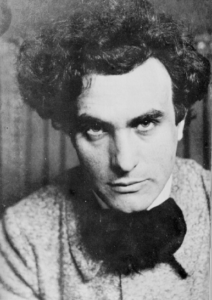 Edgard Varèse (1883-1965) was born in Paris. He moved to America in 1915 and spent most of his professional life here. He studied music at the Schola Cantorum and the Paris Conservatory. He also spent a good deal of time studying engineering in Turin because his father did not approve of his pursuit of music as a profession.
Ionisation, written between 1929 and 1931, is generally considered the first work for percussion ensemble. There is some debate about that status since Shostakovich included a percussion ensemble as an interlude in his opera The Nose (1928). Some also point to Tcherepnin’s Symphony No. 1 (1927) in which the second movement is played entirely by unpitched percussion. I could make a good case for either of those, but it’s true that they were both merely parts of a larger work.
Ionisation is far more ambitious than these other works in terms of its instrumentation and complexity. People were initially reluctant to play it, considering it too difficult, until Varèse’s friend Nicolas Slonimsky conducted the premiere in 1933. That performance was well received, but subsequent performances were not. A review in the New York Times said Ionisation “could hardly be called music.”
Varèse described his music as “organized sound,” and to appreciate Ionisation, you may need to set aside any expectations for traditional rhythms and structures. The work is more of an experiment in timbre. According to Varèse, “There is an idea, the basis of an internal structure, expanded and split into different shapes or groups of sound constantly changing in shape, direction and speed, attracted and repulsed by various forces.” He would analogize this to the scientific process of ionization.
The work can be understood as organized into five sections. The first presents most lower frequency instruments and soft dynamics. The second (at approximately 1:40) is more polyphonic contrasting the military drum and bongos. A third section (3:21) is more monophonic with the instruments often playing unison rhythms. The fourth section (4:00) acts as a recapitulation. In the fifth section (5:25), we hear pitched instruments for the first time: piano, chimes, and glockenspiel.
The work had considerable influence on avant-garde composers of the mid 20th century.