
On occasion, people ask my thoughts about a tricky matter: How to introduce children to art that includes adult themes.
When that question first popped up in my “Professor Carol” adventure, I confess to being surprised. The arts historically have been created by adults, for adults. So yes, there will be adult themes in the arts.
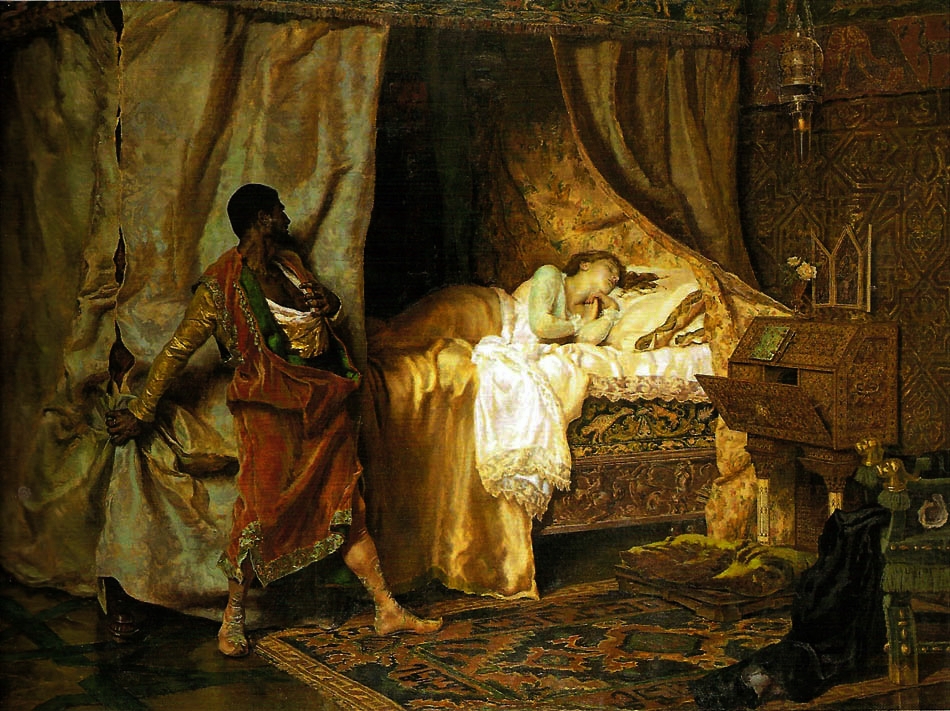
For example, next Tuesday, in our free series “A Night at the Opera,” I will be examining Verdi’s operatic rendition of Otello. Shakespeare in the hands of a team like Verdi (composer) and Boito (writer of the text)? What could be more fabulous?
Are there adult elements in the plot of Otello? Find me a Shakespeare play, or any drama of merit, with no adult themes? Good plays are, by their very nature, built around the most intense aspects of life. A play that is purely joyful and naïve won’t engage adult audiences much further than Act I.
So yes, Otello, like Hamlet and Macbeth, and even Shakespeare’s comedies, have elements not designed for a child’s level. So too does Mother Goose, if you really look at it: stolen tarts, bare cupboards, and spiders attacking little girls.
So, for that matter, does the Bible in both the Old and New Testaments. John the Baptist’s story is not, by any stretch, going to get a G rating (not with Salome and a beheading in the picture). Nor will the majority of stories about significant figures like Mary Magdalene or King David. For that matter, does anyone want to slap a rating on The Odyssey or The Divine Comedy?
So what are we to do? Clearly the answer to this quandary could be framed in endless detail, but let me give a partial answer, directed specifically to the question of opera.
To present the magnificent world of opera to younger children, I encourage a parent, tutor, or curriculum-developer to do what one does when teaching Bible stories or Classic literature: go directly to the core value of each story.
We discussed this last night in our ongoing webinar series on storytelling with Jim Weiss. Often the difficult details can be filtered while still retaining the core message of the story. This process happens frequently in the telling of fairy tales, fables, and legends.
And with opera, that means going directly to the music itself.
The melodies of opera are its treasure. You cannot go wrong bringing these melodies to a child. So, follow this rule and rely initially, or solely, on the musical elements in whatever operas you choose to present. Admittedly, some works will be better candidates than others for younger children, but the “musical rule” remains the same. Let me give you an example.
Benjamin Britten’s Peter Grimes (1945) is a fascinating, ground-breaking work, with complex layers of meaning that will be clear to adults. It has sad moments and ends sadly. But Britten framed it around six contrasting instrumental numbers he called “Sea Interludes” that reflect various moods of the ocean, from placid shimmer to raging storm. These fabulous pieces can be played individually or as a group (as they often are in concert) for any child, perhaps encouraging the child to make up poems about the sea or draw pictures that correspond to the emotions of the music.
Remember, too, that the themes and sub themes of a plot are not at the forefront of children’s perception of drama. Carmen is not a happy tale, yet the music is far too exciting to ignore. One hears it everywhere, from speakers in restaurants to background music in commercials. So expect your little children hearing the “Toreador March” to march gleefully around the room, replete with batons, flags, and waving scarves. Not a single young child will ask, or care, whether this toreador- character is a cad who will flip the drastic plot into its tragic end.
For middle-schoolers and high-schoolers, opera is perfect. At these ages, it is time to delve deeper. Yes, go ahead an select with some care. But kids of that age are so ready for real content. I contend, and will stand on any soapbox you give me to support this, that tweens and teens are exposed almost every day to things that make the wildest opera plot pale by comparison!
Alas, we live in a world where a trip to a store surrounds all of us with magazine covers that would have been labeled pornographic in my childhood. Should I mention the vile words and images worn openly on T-shirts? Or the violent, misogynist rants of rap that blare from the car alongside you at a traffic light, penetrating your ears even if you close the windows.
So, now that I have that out of my system, let’s get back to opera. Here are just a few examples (there are many more) of opera excerpts that will appeal to children, in addition to those mentioned above.
- Aria: Nessun’ dorma. Stunningly beautiful, concise aria from Puccini’s Turandot. It has developed a pop status and can be found all over YouTube, performed by super-virtuosi who should, and many who shouldn’t, sing it.
- Duet: La ci darem la mano. A charming duet from Mozart’s Don Giovanni. The subtext is adult, but the music is simple, tuneful, and instantly memorable. It offers a good way to encourage children to learn phrases like “Give me your hand” in Italian also.
- Overture to Wagner’s Die Meistersinger. Children can imagine endless heroics listening to this hearty piece. Wagner’s operas are filled with legendary characters, some admirable, some villainous. The plots have strong moral messages. These operas flabbergasted his original audiences and continue to intrigue opera-lovers worldwide. (Die Meistersinger happens to be a comedy, a long one, but the music is still grand.)
- Overture to Rossini’s Barber of Seville. No one captured orchestral energy or fun like Rossini when he set pen to paper to write an overture. The overture to his opera Cenerentola (Cinderella) is just as delightful.
 Arthur Rackham, Hansel und Gretel (1909)
With any opera you present to children in video or live form, you should watch it first. Some have themes and psychological layers that are too subtle to be of concern or that may simply require a little explanation. Even Gilbert and Sullivan operas and Humperdinck’s Hansel and Gretel can fall into this category, particularly in modern productions if directors push the envelope in how the story is staged or costumed. Sometimes troubling scenes will be handled subtly, but other times not. It’s hard to be subtle about Otello’s strangling of Desdemona. (Shakespeare, ladies and gentlemen. Shakespeare.)
Choose accordingly, but also keep in mind that children are born with a natural understanding of good and evil. Especially as they grow older, they need to see conflicts that play out, but are resolved positively. They want evil and virtue to get their just rewards, and theatrical dramas like opera are great vehicles for this to occur. They also can understand the concept of “redemption” which shapes many an operatic drama, particularly from the 19th century forward.
Finally, classical music and acknowledged masterpieces of dance, theater, art and literature serve as conduits of beauty that every child should experience. While adult themes need to be handled carefully, a steady diet of mindless cartoons and light children’s fare is not enough. Ultimately you, the parent, have to guide the child through life’s lessons. Let the great artistic works of our Western heritage help you do just that while you hone your skills as good editor and loving gatekeeper.
You know my love of opera and educating young children so this was a most enjoyable and meaningful article.