
Johann Sebastian Bach
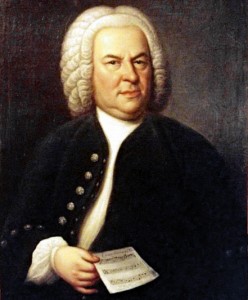
Born: 1685 in Eisenach
Died: 1750 in Leipzig
Era: Baroque
Please refer to the Listening Form for further instruction.
What is a Concerto?
Musical terms can be confusing because sometimes a term that means one thing in one era means something different in another era. We tend to think of the concerto according to what it meant in the Classical and Romantic eras: a piece written for a solo instrument (often virtuosic in character) accompanied by orchestra. Beethoven’s Piano Concerto No. 1 (one of the assigned works for Discovering Music) would be a good example of the Classical “solo concerto.”
“Concerto” literally means in concert—playing together. In Bach’s time, that didn’t necessarily mean a solo instrument playing “in concert” with an orchestra. It often meant two or more instruments (a small group, or concertino) playing with a larger group of instruments (ripieno). This Baroque style is known as concerto grosso, and it was popular with composers such as Corelli, Vivaldi, and Handel. While the name concerto focuses on the “togetherness” idea, the interesting dynamic lies in the contrast between the small group (or soloist) and the larger group.
This Brandenburg Concerto features a concertino made up of trumpet, recorder, oboe, and violin. Each is given an important and more-or-less equal role as a solo instrument. The trumpet has a tendency to dominate because of the power of its sound, and this is particularly true when a modern trumpet is used. In the latter part of the 20th Century, performances on historic “period” instruments became widespread.
The Baroque Trumpet
Bach intended the trumpet part to be played on a “natural” trumpet, meaning one without valves. Valves have the effect of changing the length of the tubing, which changes the frequency of the vibrating column of air. With a valveless instrument, however, the player is limited to notes within the overtone series of a single length of tubing. The player changes notes merely with variations in his embouchure (lips and facial muscles). As you move higher in the overtone series, the notes that can be played on the instrument are closer together. Consequently, the trumpet has more notes available and greater melodic possibilities in the higher registers. A virtuoso style of playing in this high “clarino” register of the trumpet was developed in the Baroque era.
You may see the trumpeter’s fingers moving on a natural horn as he covers small air holes or vents in the tubing. These vents were used merely to correct certain intonation problems inherent in the instrument. Watch this short demonstration of the valveless trumpet playing in the clarino octave.
Bach in the Court at Köthen
The six Brandenburg Concertos date from Bach’s post at the Court of Prince Leopold in Köthen.We discuss the various “Stations of Bach” in Unit 7 of Discovering Music. The concertos are unrelated to one another musically and may have been written as early as 1717. But it was in 1721 that Bach prepared a presentment copy of the scores with a dedication to the Margrave of Brandenburg-Schwedt. Bach hoped the Margrave might offer him a new post, but the scores sat unnoticed in the Margrave’s library and remained unpublished until 1850, the centenary of Bach’s death.
This performance by the Freiburger Barockorchester was recorded in the hall at Köthen that we visited in the video above.
Further Reading
Gutmann, Brandenburg Concertos (classicalnotes.net)