
As we look toward Christmas Eve and the beginning of the Twelve Days of Christmas leading to Epiphany, may I suggest, once again, this beloved short masterpiece, Amahl and the Night Visitors. I can think of no musical work more perfectly crafted, more lovely, or better able to resonate in our hearts and minds at this season. This post appeared in one of our past Advent Calendars.
I’ll start with a “disclaimer”:
Introducing the song “This Is My Box” from Amahl and the Night Visitors into your children’s lives (yours too, for that matter) may result in the following:
- Disruption of otherwise normal moments by hilarious interjections of “This is my box” or “I never travel without my box.”
- Exuberant singing, dancing, and using this melody to comment upon objects (particularly any object resembling a box).
- Spontaneous outbursts of Point #2 upon random references to phrases like “I never travel,” “this is my,” or “in the first [second, third] drawer,” and most definitely to the word “licorice.”
Fortunately, these phenomena have no negative side effects . . . unless someone is taking a nap!
Do I overstate the infectious nature of the aria “This is my Box,” sung by King Kaspar, the oddest of the Three Wise Men? You’ll have to see what happens in your family. Let me tell you a bit more about it, and about this whole wondrous work.
In the story, the Three Kings stop at the desperately poor dwelling of a crippled shepherd boy Amahl, and his long-suffering mother. These seekers are pursuing a Wondrous Star and bear a load of treasures that include many boxes. But the most interesting box is filled not with supplies. Nor is it a gift intended for the unknown baby. No, this box contains King Kaspar’s favorite items, without which he simply does not travel.
Amahl, too, has been watching the star. As the piece opens, Amahl is transfixed by the celestial phenomenon and its unusual “tail,” frustrating his mother by effusive descriptions of it and by his petitions to stay outside longer to watch it.
Eventually, Amahl acquiesces and comes in to sleep. Minutes later the exotic visitors arrive, setting things into an uproar as they enter, decked in glittering brocades with a lone servant dragging their trove of treasures. Amahl’s mother has neither food nor fuel nor a bed to offer her guests. Still, being a practical woman, she leaves to gather twigs for a fire. While she is gone, Amahl takes advantage of these precious minutes to approach the kings and ask his own questions. “Are you a real king?” “Have you regal blood?” “Where is your home?” One of the kings charmingly asks the boy what he does. Amahl’s answer will touch your heart.
Then Amahl asks King Kaspar directly about the box: “What is this?” That is when the fun starts.
Kaspar’s answer “This is my box” may not sound particularly engaging. But it is, once his quirky manner and Menotti’s funny words and bouncy music come together.
The words (libretto) and music in Amahl and the Night Visitors were created by the marvelous Italian-American composer Gian-Carlo Menotti (1911-2007) under commission from the National Broadcast Company (NBC). The idea of writing an opera for television to air on Christmas Eve, 1951, was both curious and promising. Remember, back then people expected the new medium of television to become a prime vehicle for bringing fine culture to the masses.
Menotti, already successful as a composer, took the commission gladly, yet was stymied as to how to proceed. The clock was ticking. Finally, in frustration, he entered a gallery of the Metropolitan Museum in New York City and experienced a revelation when he passed by a small, famous painting by Hieronymus Bosch called The Adoration of the Magi (c. 1475).
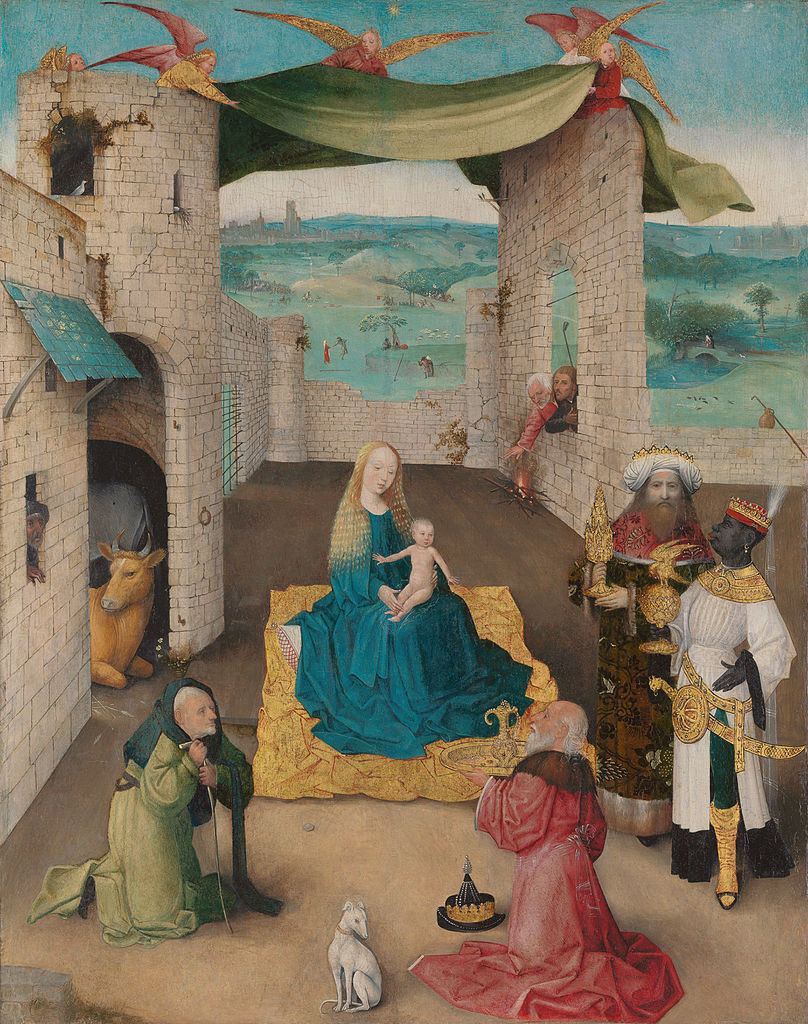
This painting instantly reconnected him with the loveliest memories of his Italian childhood. Recalling the feelings of waiting with his brother for the Three Kings to bring Christmas gifts, Menotti’s heart opened and the opera nearly wrote itself. He tells the story charmingly in the introductory minutes of the original broadcast, archived here (go to 23:07 for “This Is My Box”).
In past Advent Calendars, I have written about this work. Also, I related the story of receiving an email from the extraordinary singer Rosemary Kuhlmann (1922-2019) who sang the premiere role of the mother in 1951. Somehow Kuhlmann was alerted to my first Advent-calendar post on Amahl and decided to write an email and express her pleasure at the post. It was a high point of my life to open that email with its reference line “from Amahl’s Mother” and realize who had sent it. I sank to the floor and cried happy tears.
Partly my love of this work stems from sitting, as a child, transfixed before its annual broadcast on Christmas Eve. A bigger part of my enthusiasm, though, comes from the fact that every measure of this brief work (c. 55 minutes long) is perfectly constructed. The story itself covers the simplest and most complicated of human feelings. Opening with the heaviness that longstanding poverty and illness bring to people, the opera moves briskly through a full range of emotions as contrasting as frivolity and anger, ending in a wash of awe and joy. The climax of the work comes when the mother’s helplessness leads her to attempt a small theft in hopes of feeding her child. A showering of redemption comes quickly (with a musical luxuriousness that is unforgettable), quickly followed by an even greater moment of redemption in an illumined scene capable of bringing shivers to your spine. (No, I’m not going to tell you, but get the Kleenex out.)
If you have never seen Amahl and the Night Visitors, let it be a gift to your family this Christmas season. There are DVD and VHS versions available, as well as multiple offerings on YouTube.
In the past, I would also say: “Look for a local production.” Once common, these have become harder to find, in part because of today’s flashy “consumer tastes” and also because a production requires a boy soprano capable of singing the challenging role of Amahl. In today’s world, especially in the United States, few boys benefit from early, rigorous vocal training, especially the kind widely provided by boys’ choirs in past eras. And while a female dressed as a child can make the role work (I’ve seen it done quite nicely), Menotti was clear in his instructions that a child’s voice should anchor and shape the magical flow of the music.
Meanwhile, remember that the filmed versions will not have been designed for massive Smart TV’s with HD quality. If your children are not accustomed to black & white or older films, help them sink into the atmosphere. Kids do adjust, although it could take a second viewing to draw them in, especially if they are new to the idea of sung drama. Try to watch Amahl and the Night Visitors at a quiet time when things are feeling intimate and “Christmassy” so that its magic can override the noise and bustle of daily life. The story and melodies will speak for themselves.
Thank you!
Merry Christmas!
Blessings to all in the New Year!
Thanks for the hint, Carol! I have heard of “Amahl”, but have never listened to it. I will look for it on YouTube.
Merry Christmas to you and your family. Please travel safely!
Bob LeFevre
Merry Christmas to you, Bob, and your family, and to you Shinwoon!
This is one of my mother’s favorites. When she was a young wife and mother, she choreographed the dancers bringing food to Amahl’s mother for a local church that put on the play. We listened to Amahl every Christmas and it’s now one of my favorites. I have so many memories of my whole family singing along with all the parts and acting it out as we made Christmas cookies, etc. Thank you for sharing!