
A lot of people put up Christmas trees this past weekend. We happen to be of the “As-Close-to-Christmas-Eve-as-Possible” ilk, but among Americans, we are in the minority. In my childhood, though, a tree put up later than December 10 was simply late! And late, in my mom’s eyes, was not good.
Once everyone’s tree goes up—which can go smoothly or bring on flashes of family trauma—the lights and decorations follow. As the final step, generally the Nativity Set (crèche, manger scene) is placed under the tree. Voilà, it’s time to sit back and enjoy, or at least ponder who gets to clean up the mess made in the process.
We have written in past Advent Calendars specifically about Nativity Sets: their extraordinary history, artistry, beauty, and value. Reference has been made to wonderful museum collections, starting in Dresden and Munich, and other stunning ones world-wide. Nativity Sets can have dozens, even hundreds of characters, human and animal, and be built into a surprising number of layers, especially if crafted for characters to wander through a craggy setting en route to the Baby Jesus. Those designed for kings and cathedrals may be inlaid with precious jewels or carved from the finest stones known to man.
The simple crèche I grew up with had none of those features. It was the basic utilitarian manger scene Americans families could get after the Second World War, likely bought at Woolworth, Kresse, or Sears Roebuck. Today if you owned one in pristine shape, it would have value!
But then, we were just glad to have it come out of its carton in December. It was made of bisque and carefully painted. It also chipped easily (although surely I was rough on it, since I spent most of December playing with it under the tree). I loved every figure, especially the Angel who had a wire bent into her back to hook into the fascia at the peak of the pressboard, straw-studded roof.
I loved every figure except the camel.
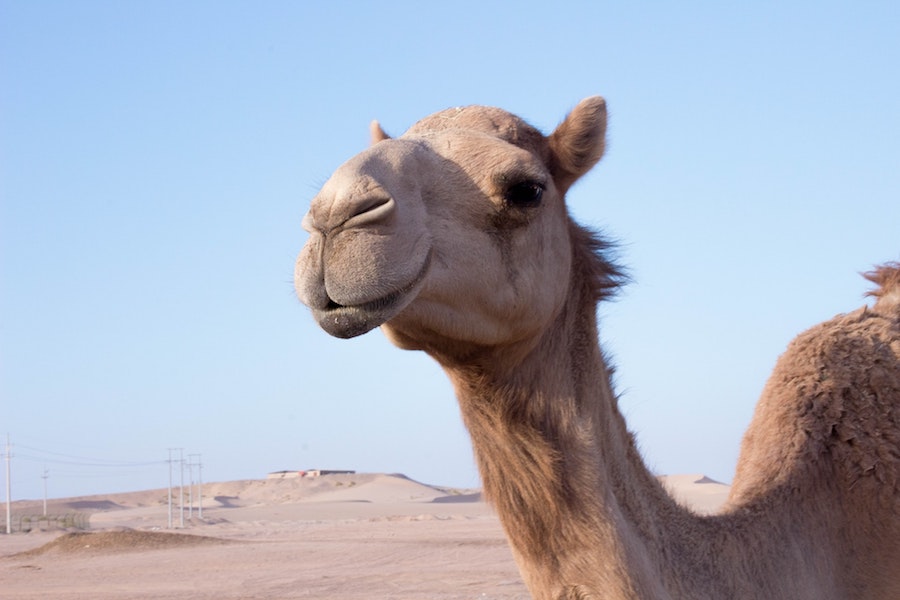 I just didn’t like the camel. Partly it bothered me because it had one hump, which I found odd. Camels in my story books had two humps. With just one hump (I reasoned), where would a king sit?
Clearly, I didn’t know that the one-humped Dromedary makes up c. 94% of the world’s camels, and that it would have almost definitely been the species in the region of Christ’s birth. Those two-humped camels, the Bactrian, stem from Central Asia, not the Arabian peninsula.
But the bigger problems I had with this camel figurine were two: if there were Three Kings, then why did the set have only one camel? Furthermore, what was a camel doing in the snow? Apparently, I had enough geographical sense in my young mind to know that camels don’t live in the Alps, which is where I figured Jesus was born. Okay, if I was that confused, I clearly had no geographical sense.
But seriously, Jesus had to be born somewhere snowy, right (based on the rows of Christmas Cards my mother loved to lace together and string across the mantel)? From their polished and foil-covered covers beamed Joseph, Mary, the Babe, shepherds, and the rest of the cast in desert clothing . . . surrounded by hills covered in flecks of glittery snow. Sheep, cows, even goats fit with northern climates, but camels?
There are major disputes about the many references to camels in the Scriptures, including one called the Case of the Phantom Camel arising from a set of specific archeological evidence. Such debates can be fascinating, but they miss entirely the point of the Bible and fail to prove a biblical narrative is invalid. Instead, anachronisms and apocryphal elements give vivid and essential insight into each story, illuminating the spiritual community at any given time and place.
So, sidestepping all of these debates, let’s focus on one thing people do know about biblical times: camels were signs of wealth and developing trade routes.Mentioned between 20 and 80 times in the Bible, depending on translations, camels often are carrying valuable loads and their cargo will be noticed!
[T]hey lifted up their eyes and looked, and, behold, a company of Ishmeelites came from Gilead with their camels bearing spicery and balm and myrrh, going to carry it down to Egypt. (Genesis 37:25)
They were widely used in war, too. Documented camel cavalries first occurred in 853 BC and still were employed in World War II.
Camels do not plod, either. In I. Samuel 30:17 we read of them as swift get-away animals for the lucky 400 who escaped King David’s wrath:
David slaughtered them from the twilight until the evening of the next day; and not a man of them escaped, except four hundred young men who rode on camels and fled.
But despite all of these mentions, they are not described in accounts of Jesus’ birth. In fact, only Matthew’s Gospel mentions the Magi, or Wise Men. Still, if the Wise Men were being outfitted to bring costly gifts across vast expanses, then camels were the way to travel.
Camels are capable of traversing long distances across difficult terrain. Their ability to go without water is legendary and true. They have multiple eyelids and eyelashes to ward off gusts of blowing sand in the desert. Their mouths are made so as to grasp and pluck any shred of nutrition off the roughest sprig of thorny vegetation. Rather than hooves, that have large foot pads that grip far better in desert sand.
And they could flee far! Carrying up to a 1200 pound load, they can travel 35 miles without water, even in harsh desert conditions. When camels refill, they can soak up 30 gallons of water in only 13 minutes.
In short, they are survivors.
Of course, the Magi could have ridden horses, another status-laden animal that the average person could never hope to afford. But imaging the Wise Men pulling up to Christ’s cradle on Trigger doesn’t have quite the right atmosphere, does it?
Christian history and tradition are greatly shaped by prophetic statements like this one about camels in Isaiah 60:6:
A multitude of camels will cover you,
The young camels of Midian and Ephah;
All those from Sheba will come;
They will bring gold and frankincense,
And will bear good news of the praises of the Lord.
Finally, there is that marvelous line that we all need to remember far more often in Matthew 19:24:
And again I say unto you, It is easier for a camel to go through the eye of a needle, than for a rich man to enter into the kingdom of God.
So, if your Nativity Set has a camel, set it up on the table and see what you and your children can do to explore its nature and role in Bible times. Maybe this gives rise to finding a book or documentary on camels (surely there are many), sifting through old Christmas cards or the staggering number of images of museum-quality crèches to be found on the Internet. Or, simply enjoy as the little ones play with the camel and recreate the story of all of the figures making their way towards the cradle of Christ.
Postscript: I couldn’t resist sharing this little scene. Back in December 2019, a trio of animals—a cow, a donkey, and a camel—were found wandering the back roads outside of Goddard, Kansas, looking like a company of beasts en route to a live Nativity Scene. The article I found in the British paper The Guardian failed to explain how they came to be out on their own, but did say their owner turned out to be a supervisor at a wildlife park. They were coined “the three friends traveling together (towards a Northern star).”