
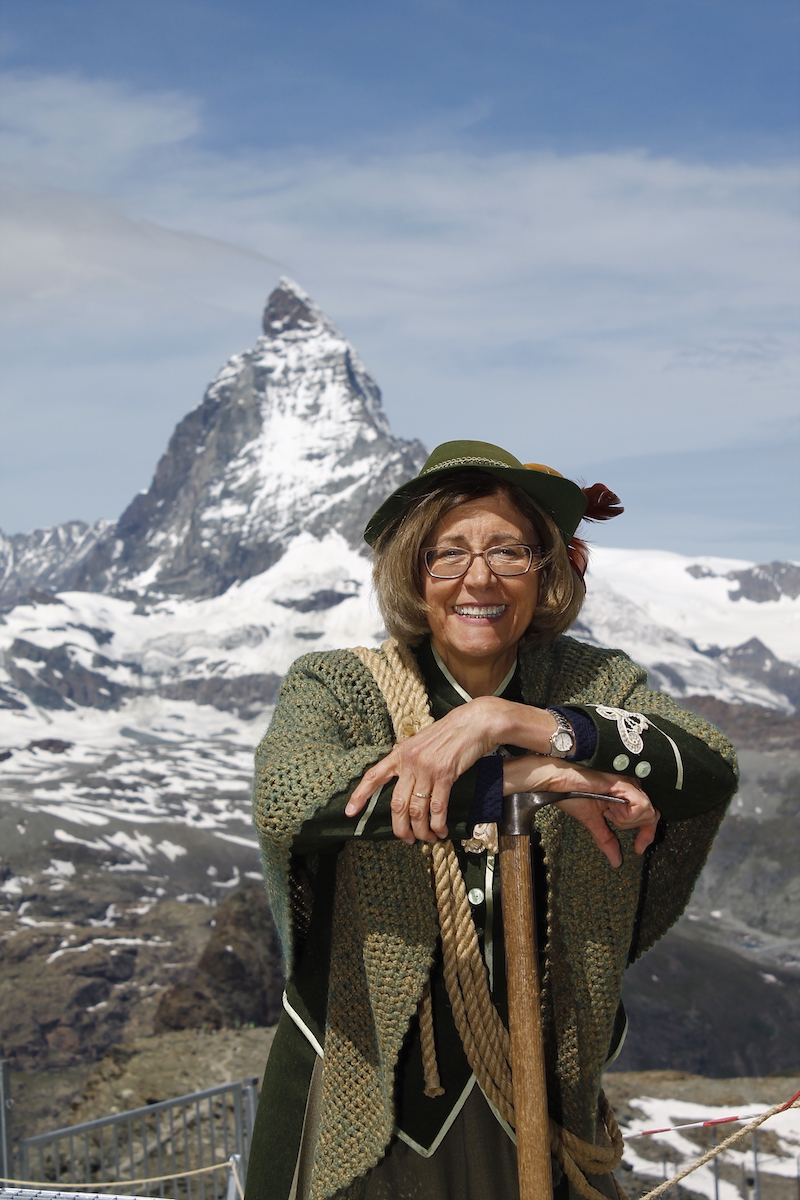
 Yes, that is the Matterhorn behind me. Not a photoshopped Matterhorn. Not a backdrop of the Matterhorn. The real thing.
At the Gornergrat (an alpine ridge reached by cog railroad and perfect for viewing the Matterhorn) our guide related that such clarity of sky was rare. She could count on her fingers and toes how often the Matterhorn’s iconic peaks shone per year with such glorious visiblity.
But visible they were that fine afternoon, with nary a cloud in the sky. As you might suppose, we took dozens of photos, gazing at each other’s screens in amazement at how “fake” each shot looked. “No one will believe this is really the Matterhorn behind us, will they?”
Faked photos are everywhere these days. The practice of altering, transforming, and faking photos has become child’s play due to modern software and apps: it’s a frolic even little ones can indulge in, laughing hilariously as they trade out backdrops, put mustaches on faces, add in zoo animals, and generally shake their magic techno-wands to make whatever they want appear in a photo.
Photoshopping began with a concept developed in 1987 by Thomas and John Knoll—brothers who licensed their program to Adobe Systems the following year, leading to a 1.0 version that shipped out in 1990. If you think back to the late 80s and to computers like the Macintosh Plus, you see how far things have come regarding the layman’s ability to manipulate images on a computer screen. Not surprisingly, “Photoshop” went from the name of a specific piece of software to a verb tossed across the populace. Adobe tried to limit legally the use of the word to their specific program, but that effort was as unsuccessful as Xerox Corporation’s effort to restrict generic use of the trademark “Xerox.”
The Knoll brothers had a keen love of art. Also, their dad was a photography buff, so they grew up immersed in a darkroom. (I’ll say a bit more about that in a moment.)
Thomas pursued a Ph.D. in image processing and John worked in crafting special effects for high-budget films. You might say the Knoll brothers had the perfect combination of artistic proficiency, theoretical knowledge, and technological savvy.
It turns out that “Photoshop” spawned other trendy processes and terms for techniques to alter images on screen. One such term is “Deep Fake”—the morphing of a face so that one face could be transformed into someone else’s. Another is called “tobacco bowdlerization”: the process of meticulously removing cigarettes, pipes, and cigars from the mouths of famous figures of the past. Does taking a cigarette out of the hand of illustrator Clement Hurd in the book-jacket photo of Goodnight Moon make sense? You could make that argument (although I’d choose to tell the child that, yes, back then, adults often smoked and cigarettes were used as a standard prop in publicity photos, even with people who did not smoke!). But removing the iconic cigar from the mouth of history’s great hero Winston Churchill? That is a crime.
All of these technological possibilities easily become sister-actions in the despicable cancel culture swirling around us. Still, the idea of manipulating the images in photos is not new. The Bolsheviks were masters at erasing images out of photos, as well as changing the content within a picture. Who can forget the infamous example of bumping Leo Trotsky out of a photo that showed Lenin strolling with him during the 1919 celebration of the Bolshevik Revolution (apropos to Stalin having him actually bumped off in Mexico in 1940). But there are traditions of altering photographs for artistic effect too.

Photography itself is a miracle. The initial mastering of its materials and methods occurred across the 19th century. By the dawn of the 20th century, photographers had the means to make specific stylistic choices as to how their finished pictures would look. One of the most interesting developments was called Pictoralism wherein objects were shot through a gauzy material in order to produce a hazy effect. Pictoralism was especially popular in the years between 1910 and 1930 although earlier manifestations go back to c. 1885, at which point the goal seems to have been matching the effects of the increasingly popular Impressionist paintings.
A subsequent trend of photographic manipulation goes by the names Straight Photography or Pure Photography wherein the photographer emphasizes the subject through higher contrast, sharper focus, and richer tones. A good place to see works in this style would be the famous photos by American masters Ansel Adams or Dorothea Lange.

But to what end were these photographers altering their images? Someone like Dorothea Lange wanted her photos to express the agony of people swept into despair by the Dust Bowl. But the material in her photos was factual. Lange did not have to manipulate troubled faces or insert backgrounds of parched fields and ramshackle huts. Those things were already there.
Even if photographic manipulation is not new, it has become a far different beast. It has changed the substance of a photograph from a vehicle of verisimilitude to a vehicle of transience. Thinking people no longer trust photos to be truthful. Recently I asked some high-schoolers in one of my online classes to what degree they felt photographs today represented truth or reality. The answers, not surprising, were sobering. Basically they said “sometimes,” “it depends,” or “only if someone wants it to be.” Remember, though, that these same young people live in a world, where modern culture celebrates boys winning trophies in girls’ sporting events. No wonder very little seems solid or true to them.
All of this makes me sad. I cherish what photos historically have given us. I grew up as the daughter of a photographer and photofinisher, spending endless hours in my father’s darkroom, inhaling chemicals, and absorbing his priceless stories amid the hypnotic yellow light. Photography was authentic magic for him (he had thought about becoming a magician when he was a teenager). Still, the truths told by a photo meant something to him. “A picture never lies,” he and many others proclaimed with confidence.
We often say things like “I’m glad my parents aren’t here to see this.” It would break my father’s heart to realize the technical skills he developed across decades of labor have been reduced to touching a few buttons on a phone screen the size of an index card. He would be far more distressed to learn that this honored art of photography has devolved into a world where fake things stand just as easily as portrayals of reality.
*Updated to correct the owner of Xerox. H/T Richard Wills.
Fascinating!
Excellent essay (as usual)! Music software can also adjust reality, and I (along with my brilliant recording engineer) are guilty of fixing pitches and choosing sections which are more accurately played, putting them together into a finished product that is more “perfect” than a live performance. I like to think we’re not changing the basic piece, unlike photoshopped pictures. But it does give the listener reason to doubt the skill — and the reality — of the performers. One plus for me is that when I listen to symphonic or theater recordings from earlier decades I am in awe at the accuracy and artistic accomplishment of these singers and musicians. A lot of Broadway original cast albums were recorded on the first “day off” after weeks of rehearsal and a full week of live performance, and for the most part they sound great. I wonder how many young people think, “Oh sure they sound great. They clicked on a few icons and downloaded a couple of apps.”
That is an excellent post. Thank you.
Fascinating story on image manipulation. Deleting Churchill’s cigar? Definitely a crime. Thanks for the marvelous expression “tobacco bowdlerization.” Cool. Tiny change: It wasn’t IBM that tried to stop the trademark-weakening use of “xerox.” It was the Xerox Corp. Two separate companies.
My 16 year old son came home from school the afternoon I read this article. He said his classmates spent an entire class period discussing whether Helen Keller was actually blind and deaf or faking it her entire life. I was struck dumb by the idiocracy of the “debate” and the waste of mental energy and even waste of breath this wondering caused. After my wits returned to me I realized that Prof Carol once again articulated the reality of an entire generation raised in a philosophy of relativism. Void of Reality, of Truth, nothing is real, nothing is true. One has to question everything. There is no solid ground. How ludicrous! How exhausting! How sad! I was able to have a conversation with my son that went beyond defending one side of the Helen Keller debate. It started by reading him this article and concluded with the reality of what a blessing Truth is.