
Chopin, 24 Preludes
It seems appropriate to being the new year with a prelude. But a prelude to what?
A musical prelude generally designates an instrumental movement that precedes the other movements of a large-scale work. You might find one at the beginning of Baroque suites, for example. It tends to have an improvisatory character with a free rhythm. In the 16th century, lutenists might use a prelude as a kind of warm-up exercise and an opportunity to make tuning adjustments.
Louis Couperin introduced the prelude in a similar style to his harpsichord suites in the 17th century. Preludes also began to appear as the first of a pair of movements, as in the Preludes and Fugues of J. S. Bach.
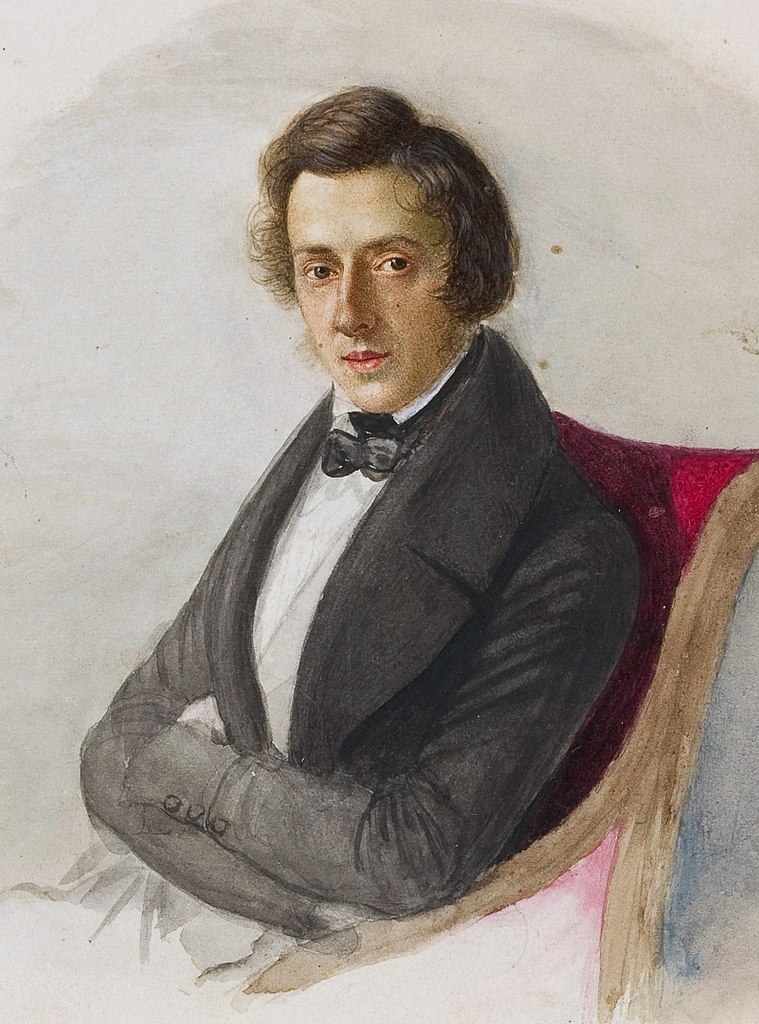
Chopin created an important benchmark in the form. His Preludes are not an introduction to something else, but stand-alone works. The 24 Preludes, opus 28 written 1836-1839, comprise a set covering each of the 12 major and minor keys, much as Bach’s Well-Tempered Clavier contains 24 Preludes and Fugues running through each of the keys.
Hummel had previously published a set of 24 preludes on this model, but his included some very large-scale pieces, indicating they were not intended to be performed as a set. Those of Chopin, however, all short character pieces averaging less than two minutes each, became the model for the Romantic era. They are also arranged in a sequence following the circle of fifths (unlike Bach’s WTC that progresses chromatically), which further ties them together in a logical succession.