
Sitting at my desk, hoping to color the advancing twilight with waves of beautiful sound (and forget the exhaustion of scooping up the previous day’s basement flooding courtesy of Hurricane Debby), I selected a two-CD set of the complete works for piano by Maurice Ravel, recorded by the French pianist Robert Casadesus (1899-1972).
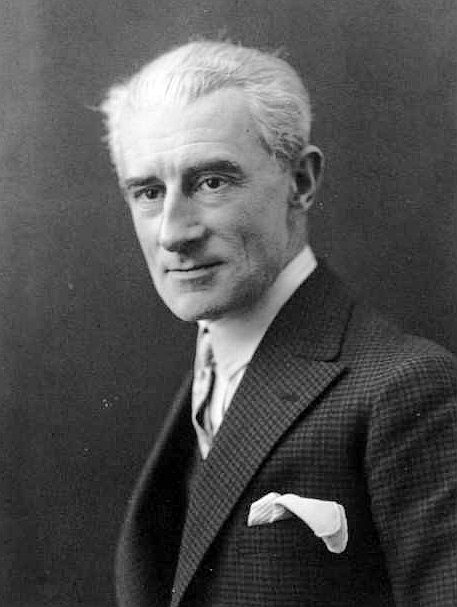
You may notice through words I offer here, in my courses, webinars, and articles, that Ravel is one of my favorite composers. Aside from Russian composers who have formed a principal part of my musical life, Ravel is the composer whose music speaks most fully to my heart. Often seriously mislabeled an Impressionist (a term no early 20th-century French composer welcomed), Ravel wrote with a clarity, precision, and tenderness that few composers achieved. At the center of his output stands a long list of works for the piano, and oh what a body of music it is!
An absolute classicist who utilized traditional forms with a freshness akin to mist on a spring morning, Ravel wrote marvelous pieces of “absolute music”—pieces shaped fully by preset classical forms—and programmatic works with descriptive titles wherein the form is determined by the expressive, dramatic content given in the title. Ravel also greatly helped revive the idea of the Baroque Suite, a genre beloved by composers like Bach and Handel, wherein short, contrasting movements are placed in a sequence.
But what is so grand about these recordings transcends even the wonderfulness of Ravel’s compositions. It has to do with the fact that they were captured with the dynamics of real performance, the kind one rarely hears today because the avenues for live piano recitals have nearly disappeared when compared to the past. Beyond that, today’s pianists, virtuosic beyond standards imaginable by the 19th-century legends, are trained to play “perfectly.” If you follow modern piano competitions, you know what I mean: judges and audiences absorb one supremely fast, nearly perfect rendition of a masterwork after another.
Since the dawn of the digital era, a performer’s mistakes, slips, imperfections, or other disappointments can be “fixed” through measures I do not begin to understand. To go a step farther, exemplary portions from one take can be edited onto another). Anyone involved in recording knows this (we do a certain amount of editing ourselves before posting materials ). The result brings listeners not just virtuosic, but perfectly executed renditions.
Unsurprisingly, the ear does get used to this almost mathematical level of perfection. That fact alone partly explains the thrill I feel bringing out these recordings by Casadesus. Maybe something was done to “remaster” or touch them up a bit in sound quality, but the actual notes flying by are the ones he played, mistakes and all. And that means that they are dominated by real torrents of passion, dramatic prowess, and exquisite quietude.
Another happy aspect of these recordings has to do with the felicitous fact that, from the beginning of his studies, Casadesus was either instructed by, or collegially connected to, the most eminent of French composers, performers, and teachers, including Gabriel Fauré and, of course, his great friend Ravel. In such cases, a performer can absorb and authoritatively convey a composer’s music at a level perhaps never to be eclipsed.
So, for several hours, I have been able to revel in Ravel’s genius—real notes filling the air, full of the kind of passion that engenders mistakes no modern recording would allow to stand. How intense those sessions between December 3 and 7 of 1951 must have been! The set also includes an earlier performance (1947) of the aurally demanding and nearly technically impossible Concerto for Left Hand that Ravel wrote for the German pianist Paul Wittgenstein (1887-1961), who tragically lost an arm in World War I.
Of course, Casadesus aimed for perfection. What good performer does not? But in actual performance, the pure power and force of musical expression does not result in note-perfect performances—not if that power is fully unleashed. And overwhelming expression was Casadesus’ first goal. Notes slipping here or there were not only insignificant, but were part of the sense of magnificence that streamed off the stage. Man meets piano. Music overwhelms man. Man overwhelms piano! Yes, Casadesus was doing battle with his concert grand, wooing its mechanics with utter mastery of every measure, aided by a confidence that he played in complete accord with the composer’s musical will.

But the story of Casadesus goes beyond these spectacular qualities. His playing was inseparable from the life he lived with his beloved pianist-wife Gaby (1901-1999). Their long union and tender musical complicity led not just to an outpouring of legendary performances and recordings (including many works for duo-pianists), but to a guarding of his well-being. Gaby outlived Robert by twenty-five years, surviving the double tragedy of their son’s death (also a brilliant pianist) in an auto accident in 1972 and her husband’s death largely from grief shortly thereafter. Her intense work to preserve his legacy of recordings and compositions also included founding the Cleveland International Piano Competition which, until 1994, was known as the Robert Casadesus International Piano Competition. In short, where so many biographies of artists are grim, even unsuitable for study by children, here are two biographies of musicians whose lives were inspirational.
Ordinarily, if I were to extol a performer or composer, I would demonstrate my case by linking to clips from their “online presence.” There is a lovely website created by the pianist’s grandson. Otherwise, few clips of Casadesus’ playing are legally posted for linking, and those that exist feature music by Chopin or other composers. I can take you to the recording I am listening to, as well as one in its original format of LP (Long-Playing record). For that matter, if your used bookstores are like so many today, you are likely to discover these recordings available for little money.
Yet, if Ravel’s piano pieces are not familiar, the magic I speak of may not be apparent upon first listening. Taking in new works and responding to their performances at the same time is no easy trick. So let me more generally urge you to consider older recordings when you seek out classical music (or music in any style). Older recordings allow you to “hear” the air moving, sense the physical space that lay between performer and listener (or microphone). You will hear wrong notes. You will also hear breathing, sighs, perhaps the sound of a pianist’s arm reaching for a handkerchief to dry a key or brow, maybe even the scoot of a bench or music stand to gain a better angle. You may even hear an audience member cough.
But whatever you find, you will hear the realities of someone using body, breath, and soul to recreate masterful music. You will gain a more visceral sense of the performance, and through this, draw closer to the composer. Your experience may be as exhilarating as the one I am having tonight, surrounded by the partnership of Ravel and Casadesus, while the breeze carries the scent of still-soaked grass across the darkness into my window.