
Telemann, Sonata for Bassoon in F Minor
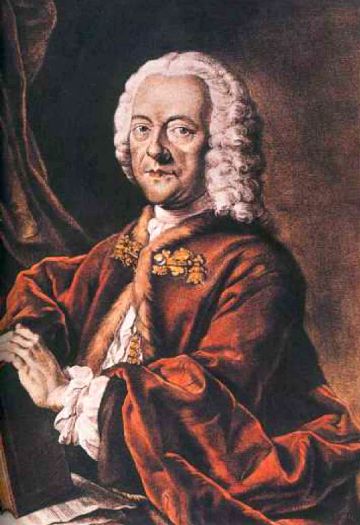 Georg Philipp Telemann
Georg Philipp Telemann (1681-1767) tends to be grouped with his famous contemporaries Handel and J. S. Bach. Four years their senior, he would outlive both—Handel by 9 years and Bach by 17. The three represent in many ways the culmination of the high Baroque. But Telemann, certainly more famous than Bach in his lifetime, tends to be overshadowed historically by the other two.
Telemann managed to produce in his long life a body of music that may exceed that of any other composer. At a very early age his talents and affability seem to have swept him into a musical profession despite his intent to study law at the University of Leipzig. In 1701, his roommate found one of his compositions and arranged to have it performed at the St. Thomas church in Leipzig (where Bach would later become Kapellmeister). He was immediately engaged to compose cantatas on a regular weekly basis and made director of the Leipzig Opera at the age of 21.
Other musicians were drawn to Telemann’s energy and his desire to take music to public audiences, volunteering to play his music at the St. Thomas church and to join with him in arranging informal local concerts. Known as the collegium musicum, Telemann would continue to foster this kind of music-making throughout his career.
Works suitable for such gatherings would naturally include solo repertoire and chamber works such as this sonata for bassoon.
Telemann is among those in our Composer Showcase, and you can find much more information and more featured works there.